EXCERPT OF THE COMEDY: Pd. 30, 22-33
Dante turns to Beatrice. Together, they rise beyond the physical universe. They are now in the Empyrean. A river of light, surrounded by flowers and emitting sparks in all directions, appears in Dante’s field of vision. Moved by intuition, Dante bathes his eyes within it.
The river suddenly appears to be a lake, and then the lake an amphitheater. What Dante at first took to be flowers turn out to be the souls of the blessed; the sparkling, in fact, drops angels.
The blessed souls sit in the amphitheater, clothed in pure white.
Each seat in every row hosts a blessed soul whose appearance reminds Dante of the many petals of a large, white rose. The divine radiance illuminates them from above. Beatrice takes Dante to the very center of the rose. She shows him the empty seats awaiting souls. One of these, she notes, will one day be assigned to the still-living Emperor, Henry VII.
EXCERPT OF THE COMEDY: Pd. 31, 1-12
Dante basks in the beauty of Paradise, warmed by beatitude and the glory of God.
A mere man from Florence, he has moved beyond the reaches of mortal life to enter the presence of the divine. He has reached the heavenly Jerusalem.
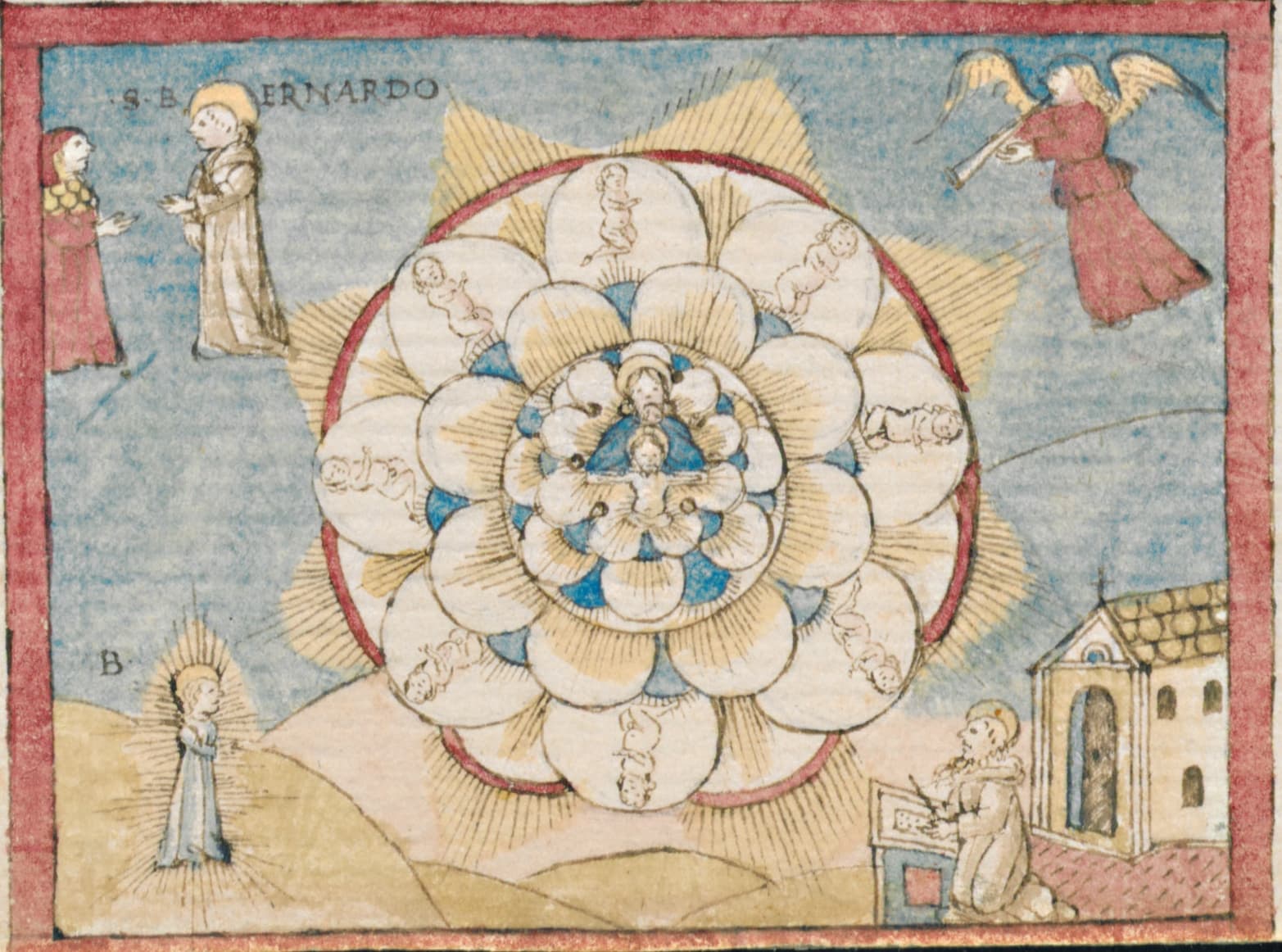
The illumination portrays the Mystical Rose with the blessed souls on the petals and God in the center. In the corners include Dante, an angel, and Saint Bernard writing one of his numerous works on Christian mysticism. - Florence, Biblioteca Medicea Laurenziana, Plut. 40.7, f. 232v.
Turning to look at Beatrice, Dante is surprised to find a white-robed man in her place. With paternal care, the man directs Dante’s gaze toward his beloved Beatrice, who has regained her seat in the white rose.
EXCERPT OF THE COMEDY: Pd. 31, 79-90
The white rose amphitheater of the blessed represents all of Christian history. The beatified souls are seated in a symmetrical order: on one side of the rose are those who lived before the coming of Christ, and on the other those who lived after the birth of Christ.
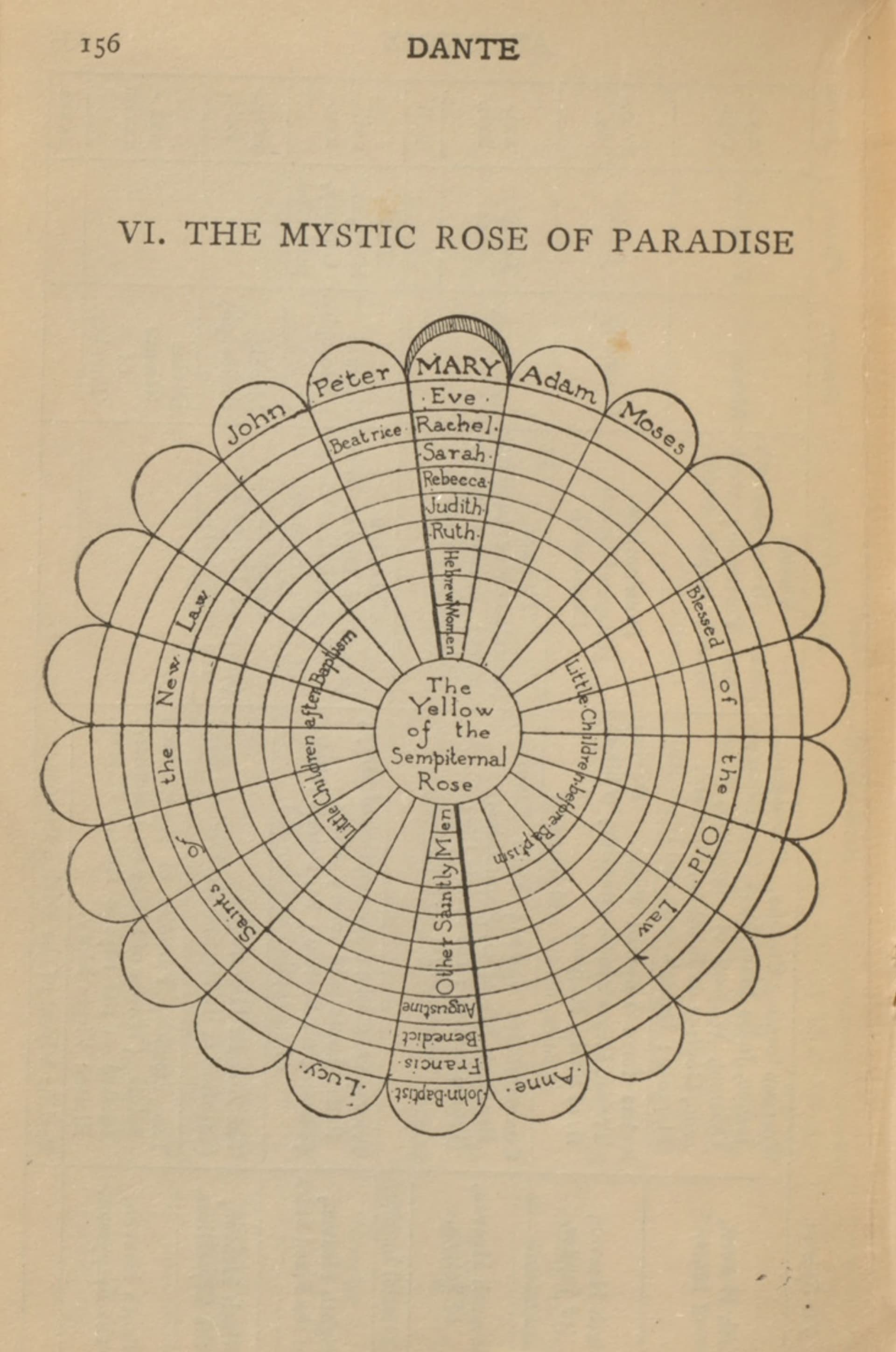
Outline of the Mystical Rose in Dante’s Empyrean. - Edmund G. Gardner, Dante, London, Dent, 1900, p. 156. McGill University Library, PQ4335 G5.
The Virgin Mary is seated in the highest row. In a vertical line below her are Eve, the first woman, Rachel, second wife of Jacob (to the left of whom sits Beatrice), Sarah, wife of Abraham, Rebecca, wife of Isaac, Judith, who saved the Hebrews from Holophernes and the Assyrians, and Ruth, main figure in the eponymous book of the Bible. To Mary’s left are Adam and Moses, and to her right Saints Peter and John the Evangelist.
Opposite the illustrious Hebrew women sits Saint John the Baptist, in the same row as the Virgin Mary. Below him are Saints Francis of Assisi, Benedict of Nursia, and Augustine of Hippo; beside the Baptist are Saint Lucy and Saint Anne, mother of Mary.
The rose’s lowest petals seat the blessed souls of baptized children who died prematurely.

Offprint of Étienne Gilson's essay on the nature of Dante's Empyrean. - Étienne Gilson, “À la recherche de l’Empyrée”, excerpt from da Dante et les mythes [Revue des études italiennes], Paris, Didier, 1965, p. 147. Université de Montréal, Bibliothèque des lettres et sciences humaines, B 721 G489.
The joy of thousands of delighted angels embraces Mary. One of the angels breaks away from the host surrounding the Virgin to float before her and recite a Hail Mary. Dante looks to Bernard, who informs him that this is Gabriel, the archangel-messenger who announced to Mary that she would become the virgin mother of God.
Bernard motions to Dante that the time has come for him to contemplate God directly. The holy man joins his hands in prayer and humbly addresses Mary:
EXCERPT OF THE COMEDY: Pd. 33, 1-9
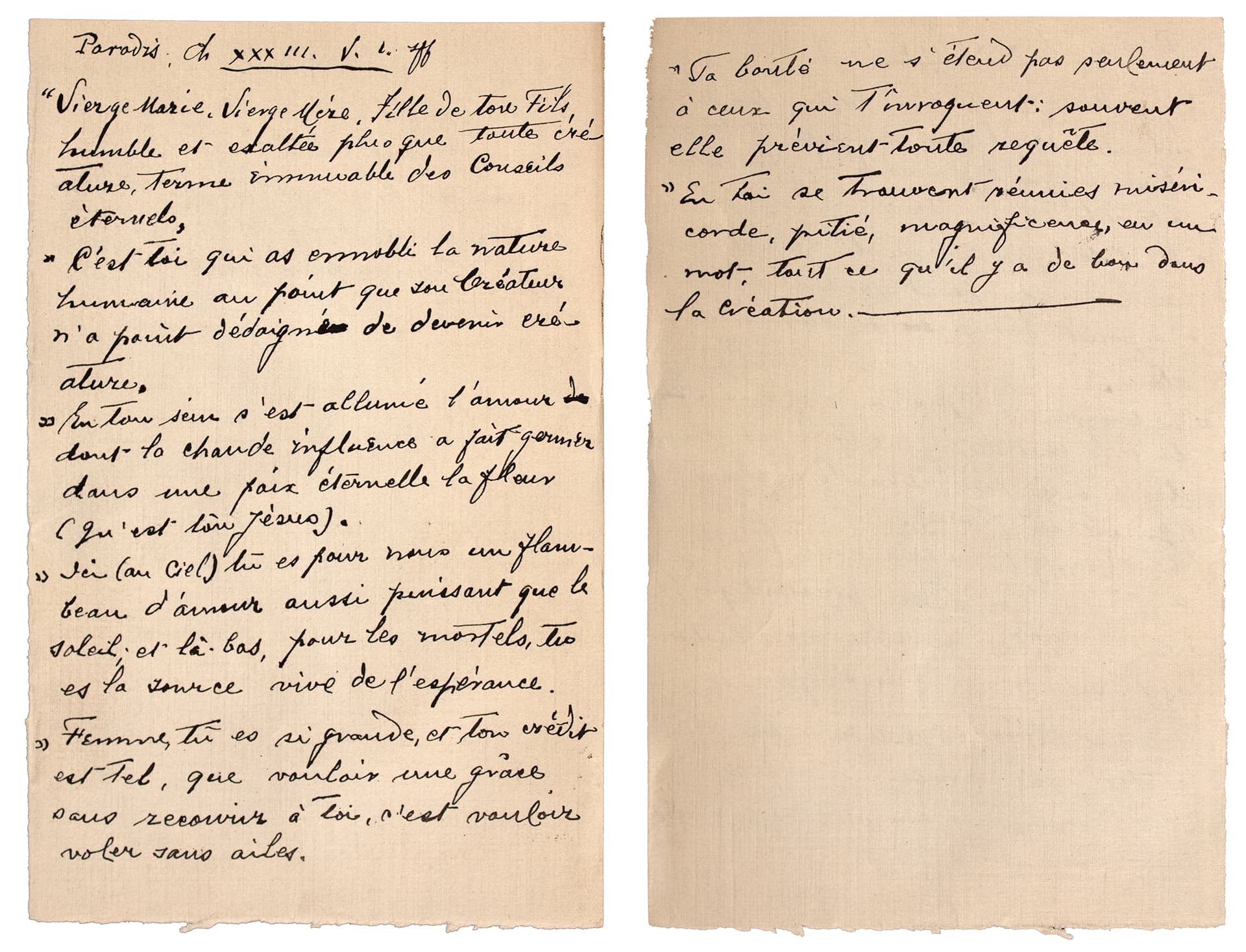
Handwritten translation of Saint Bernard’s prayer to the Virgin Mary in canto 33 of Paradise transmitted by a leaflet found inside the edition Dante Alighieri, La Divina Commedia, Avignone, Seguin aîné, 1816, t. 3. Université de Montréal, Bibliothèque des livres rares et collections spéciales, Collection générale, 851.15 D 1816.
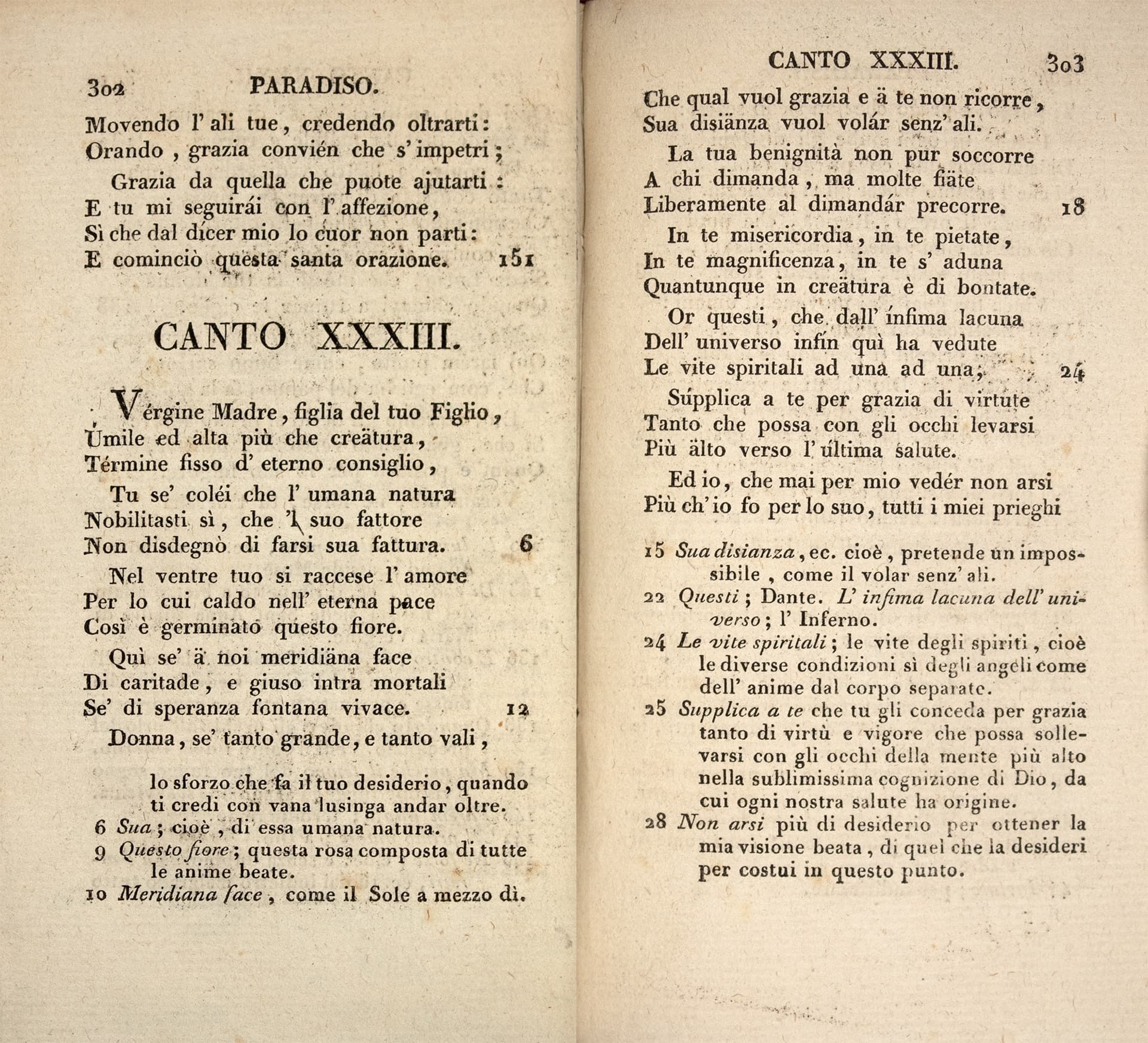
Last lines of canto 32 and opening verses of canto 33, with Saint Bernard’s prayer to the Virgin. - Dante Alighieri, La Divina Commedia, Avignon, Seguin, 1816, p. 302-303. Université de Montréal, Bibliothèque des livres rares et collections spéciales, Collection générale, 851.15 D 1816.
Dante has survived Hell, cleansed his soul in Purgatory and, now purified, ascended to Paradise.
A living man travelling through the kingdoms of the damned, the penitent, and the blessed, he has become truly exceptional: no other living soul had ever ventured so far. To contemplate God, he now needs the remaining clouds to clear from his vision so that he may see divine Truth unfolded before him. Bernard begs Mary to intercede once more on Dante’s behalf and grant the poet the mystical experience of direct contemplation of divinity as well as permission to return to the living world to share what he has witnessed. Beatrice and the rest of the blessed host join Bernard in his prayer.
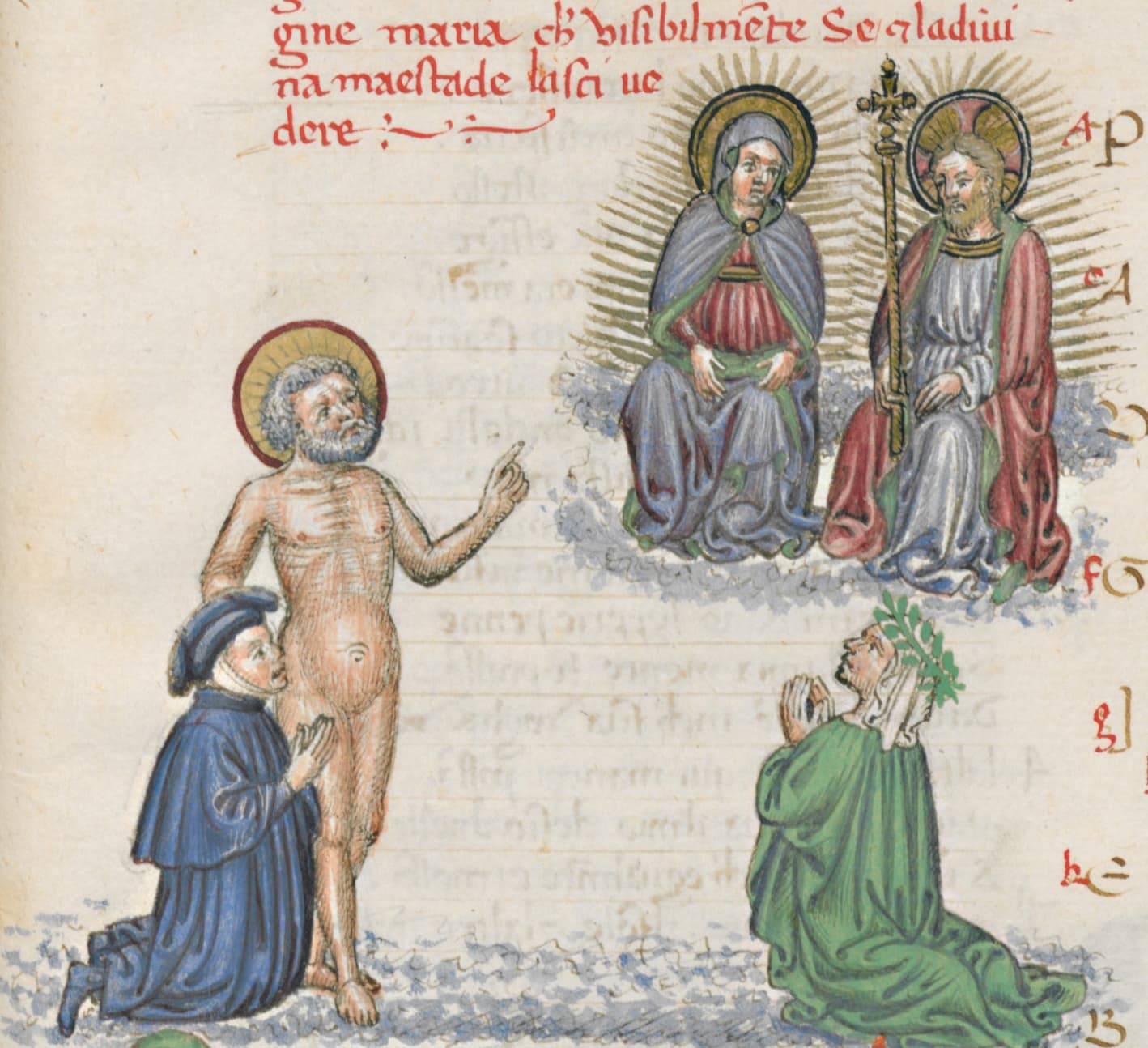
The miniature illustration shows Beatrice and the Virgin Mary as they pray for Dante’s vision of God. Meanwhile, Saint Bernard directs the poet’s gaze toward the Almighty. - Florence, Biblioteca Medicea Laurenziana, Plut. 40.1, f. 333r.
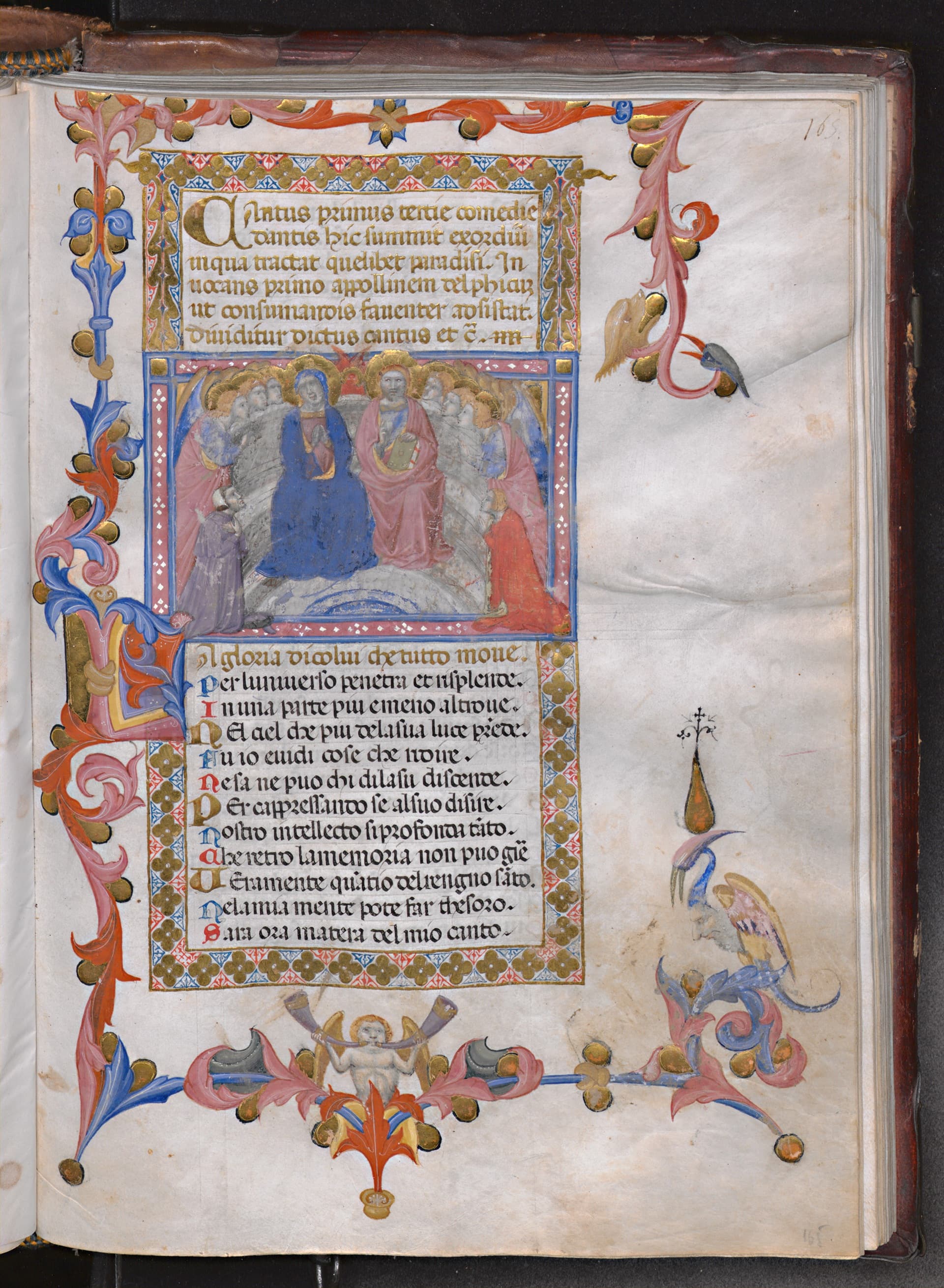
Dante beholds the epiphany of Christ Pantocrator encircled by angels, while the Virgin Mary and another figure (Beatrice or Bernard?) pray on his behalf. - Florence, Biblioteca Medicea Laurenziana, Plut. 40.3, f. 165r.
EXCERPT OF THE COMEDY: Pd. 33, 67-75
Language cannot describe what memory cannot remember.
DANTE CONTEMPLATES GOD,
THE SUPREME LOVE
THAT SETS
INTO MOTION
THE SUN AND
THE OTHER STARS
EXCERPT OF THE COMEDY: Pd. 33, 115-145
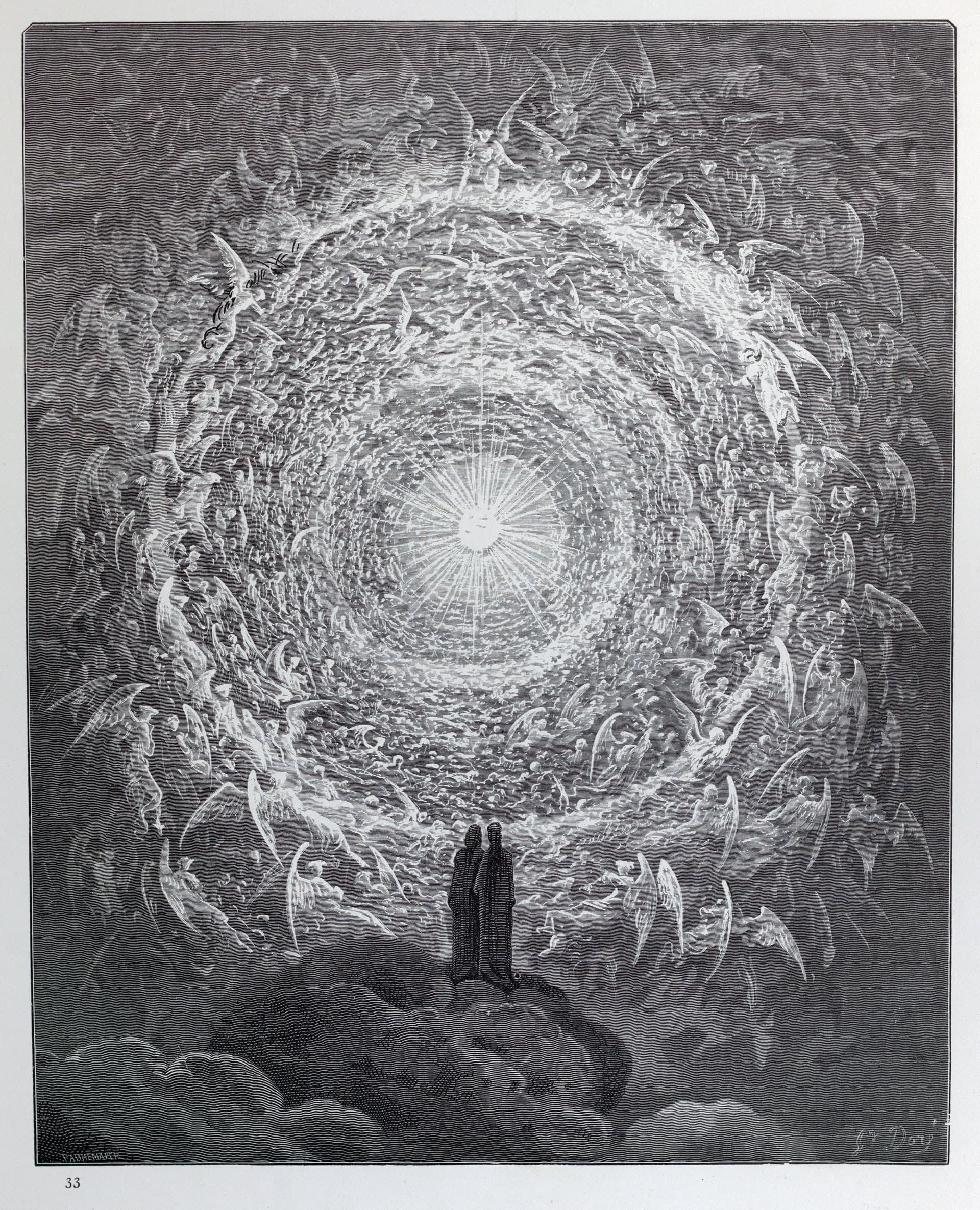
Dante and Beatrice at the center of the Mystical Rose in the Empyrean. God’s light shines over their beatitude. - Edmund Ollier, The Doré Gallery, New York, Cassell, Petter and Galpin, 1870, plate 37. Université de Montréal, Bibliothèque des livres rares et collections spéciales, Collection générale, 769.2 D695d.