
Based on the “1802” squeezed in underneath the title of the work on the title-page plate, this book is a copy of the unauthorized Roman edition of John Flaxman’s (1755-1826) illustrations to the Divine Comedy that were originally commissioned by Thomas Hope (1769-1831) and engraved by Tommaso Piroli (1752-1824). Hope commissioned the outline drawings from Flaxman in the spring of 1792, while in the midst of taking his ‘Grand Tour’ of Europe, typical of young men of his social standing at the time (Hope was the son of a well-to-do Amsterdam merchant), between 1787 and 1795 (Miller 2013, 80). Flaxman, who had gone to work in Rome from 1787 to 1794, received the commission during what would come to be known as his anni mirabiles (‘auspicious years’), 1792-1793 (Bentley 1981, 658). Although primarily a sculptor, Flaxman’s European reputation was established in these years through his neoclassical outline drawings illustrating Dante for Hope as well as through two more similar commissions, of illustrations for Homer’s Iliad and Odyssey for Robert Fullerton Udney (1725-1802) and Georgiana Hare-Naylor (1752-1806) in 1792 and of Aeschylus’ Tragedies for Countess Dowager Georgiana Spencer (1737-1814) in 1793 (Bentley 1981, 658 and 664; Miller 2013, 77).
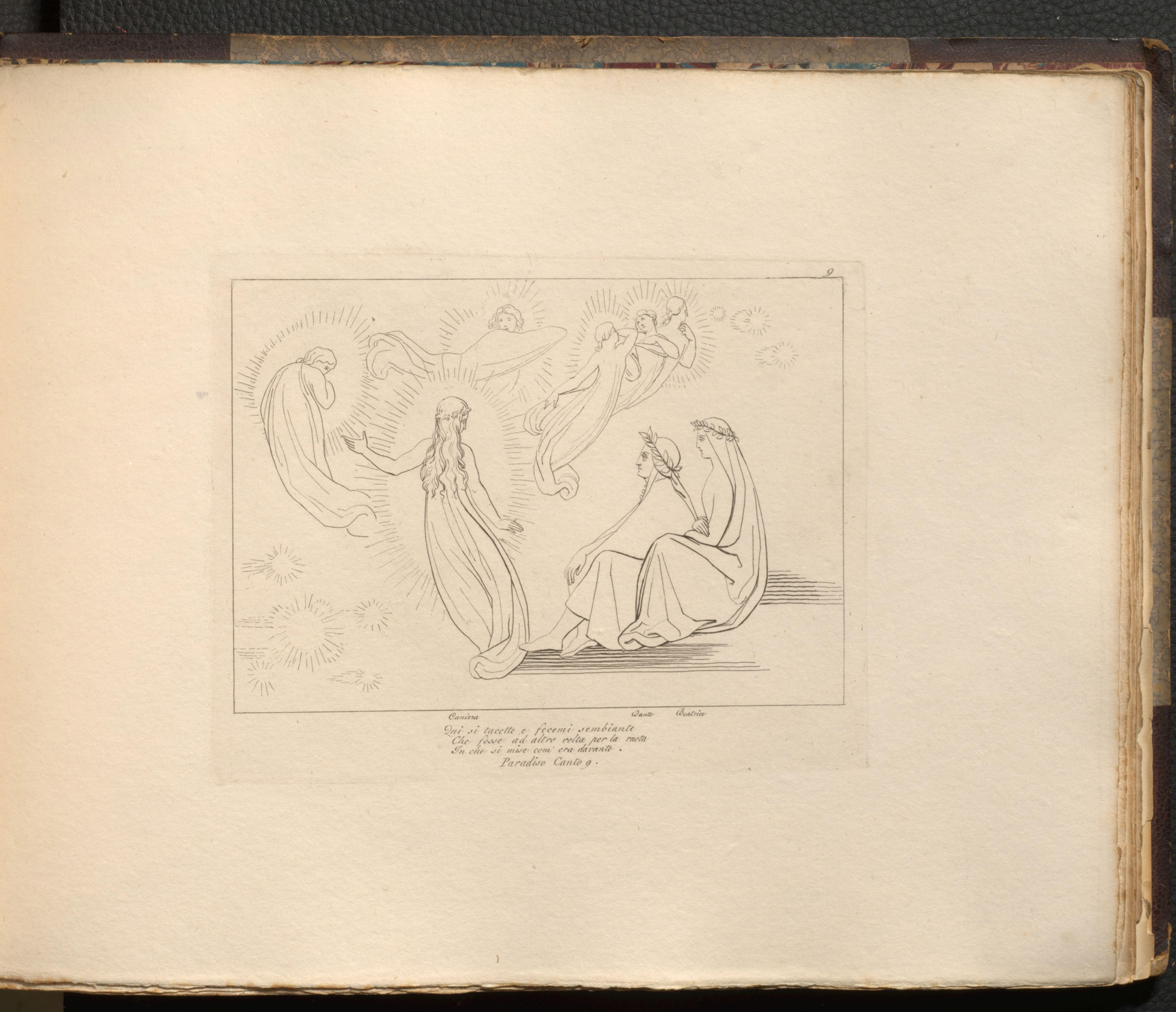
Flaxman’s Dante illustrations (as well as his Homer and his Aeschylus) were engraved by his friend Tommaso Piroli (1750-1824) in 1793 (Cardinali 1824, v; Miller 2013, 80). Two sets of artist’s proofs for the engravings are known, one of which contains plate numbers and verses in Italian added by hand by Flaxman’s wife, Ann (1760-1820), with English verses included for the first twelve plates illustrating the Inferno (Bentley 1981, 664). Thomas Hope initially kept the engravings for himself to distribute prints as gifts to friends and acquaintances, explicitly prohibiting Flaxman from publishing them himself in a letter likely from 1793 (Bentley 1981, 664; Miller 2013, 80); Gerald Eades Bentley and Charlotte Miller, however, note that Flaxman was able to print at least a few copies to use as gifts himself for other patrons (ibid). Hope later sold the plates to the Longman publishing company for £100 (the same amount he had paid Flaxman for the commission), which published the illustrations without the full text of the Divine Comedy in London in 1807 (Bentley 1981, 664; Miller 2013, 80).
A previous edition, however, was published in Rome in 1802, likely without authorization and possibly by Piroli, if the inscription, “Si vende dall’Incisore Sud.o a Strada Gregoriana N.o 34,” along the bottom of the title-page plate is any indication (Bentley 1981, 664). This edition too, of which McGill’s exemplar seems to be a copy, was published without the full text of the Divine Comedy (Miller 2013, 80). Unfortunately for Flaxman, none of the profits from any publication of his engraved illustrations ever lined his pockets. Despite Flaxman’s illustrations of Dante becoming one of the standard set of images reproduced alongside the text of the Divine Comedy until 1979, the artist had not thought to keep any measure of control over the reproductions of his work -- something many of his more financially savvy contemporaries, aware of how profitable engravings could be, had ensured for their own works (ibid).
The McGill Library acquired its copy of the 1802 Roman edition of Flaxman’s Dante in 1921, possibly in relation to both the six hundredth anniversary of Dante Alighieri’s death and McGill University’s own centenary celebrations. It is now held in the main collection of McGill’s Rare Books and Special Collections.
Full title: La Divina Commedia di Dante Alighieri. Cioè l’Inferno, il Purgatorio e il Paradiso. Composto da Giovanni Flaxman scultore inglese ed inciso da Tommaso Piroli Romano.
Author: John Flaxman (1755-1826; illustrator); Tommaso Piroli (1750-1824; engraver).
Contents: 38 numbered plates illustrating the Inferno, 38 numbered plates for the Purgatorio, and 33 numbered plates for the Paradiso; 1 unnumbered plate between the Inferno and Purgatorio. Each plate bears a brief caption indicating the verse and canto illustrated, sometimes labeling the figures in the illustration as well.
Date of publication: 1802.
Place of publication: Rome, Italy.
Publisher: N/A.
Languages: Italian
Physical description: 1 preliminary leaf and 110 plates measuring 210 x 280 mm. Brown leather binding, marbled end-papers. Engraved title page with portrait of Dante. All plates reproduced in landscape orientation, although the illustrations for plates 19, 33, 51, 66, 77, 95, and 96 were drawn in portrait orientation, necessitating the reader to rotate the book ninety degrees clockwise to see them in the correct position.
Call Number: McGill Rare Books and Special Collections, folio PQ4329 F55 1802.
Catalogue: https://mcgill.on.worldcat.org/oclc/2867197
Digitization: http://archive.org/details/McGillLibrary-rbsc_la-divina-comedia_dante_folioPQ4329F551802-20446
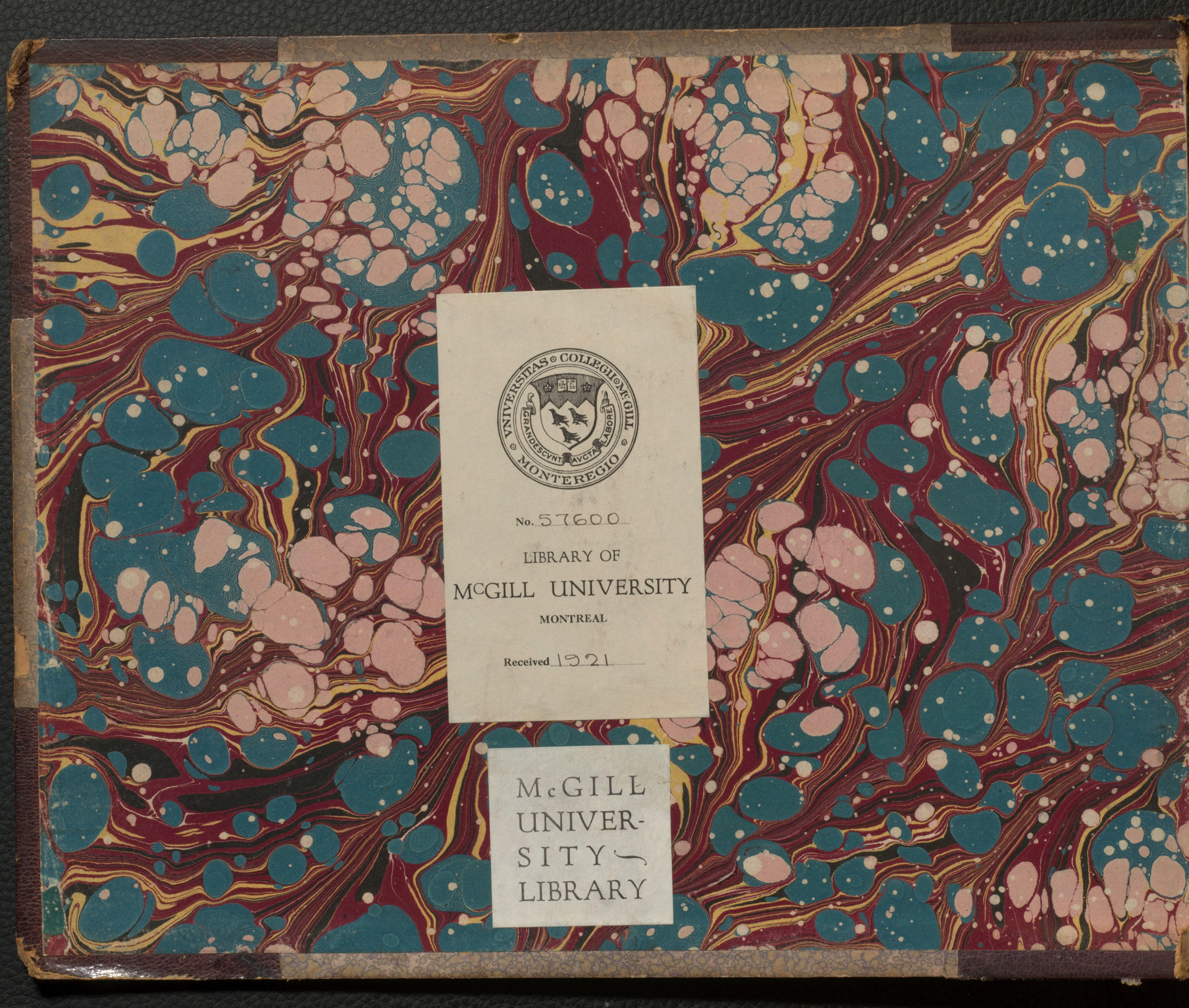
Previous owners: N/A.
Ex-libris and stamps: From top to bottom, on front paste-down, McGill Library accession sticker and ex-libris.
History of this copy: Based on the accession sticker on the front paste-down, the McGill Library acquired this copy the 1802 Roman edition of Flaxman’s Dante in 1921, possibly in relation to both the six hundredth anniversary of Dante Alighieri’s death and McGill University’s own centenary celebrations. What happened to the copy between 1802 and 1921 is unclear. The book is now held in the main collection of McGill’s Rare Books and Special Collections.
Notes: Charlotte Miller specifies that the original plates of Flaxman’s illustrations engraved by Piroli were lost at sea on the way to England for reprinting, likely sometime between 1795, when Thomas Hope returned to England, and 1807, when the Longman edition was published (Miller 2013, 84).
Bibliography
Bentley, Gerald Eades. 1981. “Flaxman in Italy: A Letter Reflecting the Anni Mirabiles, 1792-93”, The Art Bulletin, 63, no. 4, p. 658-64.
Cardinali, Luigi. 1824. Necrologia di Tommaso Piroli romano intagliatore in rame. Pamphlet. Rome: Francesco Bourliè.
Miller, Charlotte. 2003. “John Flaxman’s Working Copy of Dante’s Divina Commedia”, Italian Studies, 58, no. 1, p. 75-87.
Author and date of the record: Cay Rivard, 28/06/2021.
